

MASI Learn · Quality literacy · Pharmacopoeias
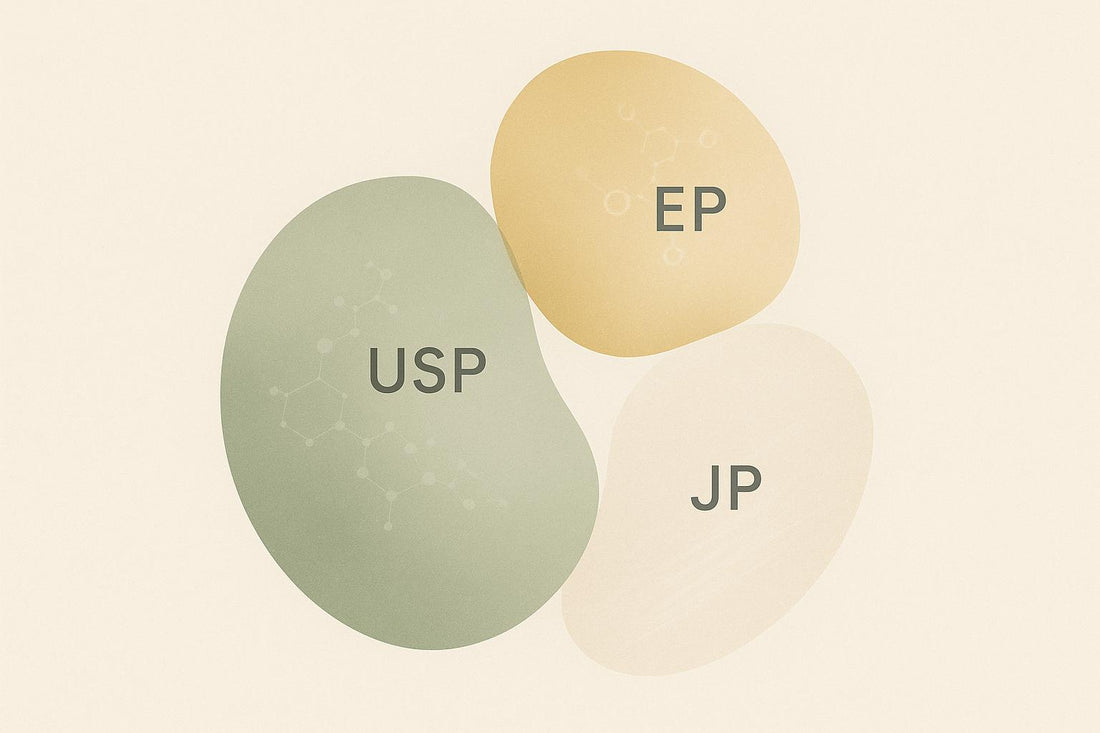
USP, EP, and JP are real pharmacopoeial standard systems — not interchangeable marketing stickers, and not proof that a longevity bottle will deliver clinical outcomes. The United States Pharmacopeia (USP), the European Pharmacopoeia (EP/Ph. Eur.), and the Japanese Pharmacopoeia (JP) publish quality standards, monographs, and test methods used heavily for medicines and, where relevant, for ingredients and analytical language.[1][2] For a MASI customer, the useful skill is reading those words honestly: they describe how quality is defined and tested, not a magic badge that replaces named milligrams, lot-level purity, or a coherent 90-day program.
This guide answers the comparison first, maps what each system is for, separates pharmacopoeia language from GMP and third-party assays, shows how to buy longevity products with eyes open, and routes you into MASI’s quality education and Premium SKUs. Education from MASI Longevity Science — not legal advice, not a certificate of analysis for any third-party brand, and not personal medical advice.
Direct answer
If you are comparing USP vs EP vs JP for supplements, you usually want to know which “standard” is best, whether a product that mentions one of them is pharmaceutical-grade, and how that should change what you buy. Honest ranking:
- They are regional pharmacopoeial systems with overlapping scientific goals but different monographs, methods, and legal contexts. None is a universal scoreboard that ranks every Amazon bottle.
- A pharmacopoeial reference is about quality definition and testing language — identity, purity limits, assay methods, and related quality attributes where a monograph exists — not automatic clinical efficacy for longevity goals.[1]
- “Pharmaceutical grade” on a lifestyle product is often marketing shorthand. Ask what was measured, on which lot, with which method, against which specification.
- For longevity shopping, still demand named actives + mg, contaminant logic, and multi-month supply honesty — then run a program you can finish. Start literacy on the Quality & testing pillar and build with transparent SKUs such as Premium NMN.
- Best next commercial move for most healthy adults shopping MASI: stop hunting badge theater; pick a clear foundation product and a 90-day adherence window. Quality language supports confidence in that plan — it does not replace it.
What a pharmacopoeia actually is
Public quality books, not a consumer award
A pharmacopoeia is a curated set of quality standards: monographs for substances and preparations, general methods, and acceptance ideas used by regulators, manufacturers, and laboratories. It is infrastructure for quality systems — not a gold star sticker that proves “this brand is the best longevity company.”
Monographs define tests when they exist
Where a monograph exists, it typically describes identification approaches, assay expectations, impurity limits, and related quality attributes. Absence of a glamorous monograph mention on a consumer label does not automatically mean the ingredient is junk; presence does not automatically mean the finished lifestyle formula is clinically optimized for your goals.
Medicines vs supplements
Pharmacopoeias are foundational in medicine quality systems. Dietary supplements and food-supplement frameworks vary by market. Smart buyers still borrow the spirit of pharmacopoeial thinking — identity, purity, method honesty — without pretending a capsule is a prescription drug.
USP vs EP vs JP — operator comparison
| System | Common shorthand | Primary geographic/regulatory gravity | What it is useful for | What it does not automatically mean on a longevity label |
|---|---|---|---|---|
| United States Pharmacopeia | USP | Strong U.S. medicines/quality ecosystem influence; widely referenced globally | Monographs, general chapters, quality language familiar to many U.S.-facing labs and brands | Not automatic proof of superior longevity outcomes vs EP/JP products |
| European Pharmacopoeia | EP / Ph. Eur. | Council of Europe / European medicines quality framework | European monograph and method ecosystem; common in EU supply chains | Not a guarantee every EU-sold bottle is equal |
| Japanese Pharmacopoeia | JP | Japan’s official pharmacopoeia | JP monographs and methods important for Japan-facing supply and registration contexts | Not a universal “Asian quality score” for global e-commerce |
| Cross-cutting idea | Quality definition | Global science of identity/purity/methods | Shared goal: reproducible quality attributes | Not interchangeable badge shopping for SERP screenshots |
For deeper MASI teaching on testing panels, COAs, contaminants, and how to evaluate longevity products without theater, stay on learn-quality-testing. For molecule programs after quality literacy, open NMN, resveratrol, spermidine, and fisetin.
Label and marketing language traps
| Phrase you see | Better question | Useful response | MASI posture |
|---|---|---|---|
| “USP grade” | Which monograph/spec, which test, which lot? | Ask for method and lot linkage | Prefer transparent specs over slogan grade |
| “Pharmaceutical grade” | Measured against what acceptance criteria? | Often undefined consumer language | Translate into identity + purity + dose honesty |
| “EP quality raw material” | Is there a relevant EP monograph and current CoA? | Supply-chain claim needs documents | Documents > adjectives |
| “Lab tested” | Tested for what analytes? Which lab? Which lot? | Partial panels can omit the hard contaminants | Teach full quality story on the quality pillar |
| “Certificate on website” | Does the CoA match the bottle lot code? | Orphan PDFs are common marketing artifacts | Lot-level thinking |
| “Made in a GMP facility” | Which GMP framework and for which step? | GMP is manufacturing discipline, not dose destiny | Necessary hygiene, not outcome magic |
Quality stack: pharmacopoeia ≠ GMP ≠ third-party assay ≠ clinical evidence
Pharmacopoeial standards
Define how certain substances/preparations should be identified and tested when monographs apply. Science of specification.
GMP
Manufacturing process discipline and control. Reduces chaos and mix-ups. Does not pick your personal longevity goals or prove a human outcome trial.
Third-party assay / CoA
A snapshot of measured attributes on a sample or lot. Valuable when scope is clear and lot-linked. Incomplete panels can still look “official.”
Human evidence
Separate lane. A pure ingredient can still lack strong human outcome data for a marketed claim. Pair quality with honest evidence grades on molecule Learn pages.
Public literature on dietary-supplement quality problems (adulteration, mislabeling, variable potency) is why this literacy matters before you commit months of adherence.[4][5][6]
Buyer checklist (use before you expand a stack)
- Named active + mg per serving — not proprietary fog.
- Identity story — what molecule/form is actually in the capsule.
- Purity / contaminant logic appropriate to the ingredient class (e.g., solvents, metals, microbes where relevant).
- Lot linkage — can documents map to the bottle you hold?
- Method honesty — assay method named when quality claims are central to the pitch.
- Supply you can finish — multi-month consistency beats weekly brand hopping.
- Evidence grade match — mechanism language is not a disease treatment claim.
- Program fit — foundation first (usually NMN for NAD+-oriented goals), then partners by role.
MASI product map after quality literacy
| Goal | Primary product | Why quality literacy matters here | Typical order |
|---|---|---|---|
| NAD+ / cellular-energy foundation | Premium NMN | Identity + dose honesty beat “pharma-grade” adjective shopping | Day-one habit for many adults |
| Core stilbene polyphenol partner | Premium Resveratrol | Form and purity claims should be readable | After NMN adherence stabilizes |
| Autophagy-oriented polyamine lane | Premium Spermidine | Content claims need clear labeling | When cellular-maintenance intent is explicit |
| Senescence-adjacent flavonoid lane | Premium Fisetin | Avoid mystery blends when comparing sources | Goal-based second layer |
| Hair-nutrition lane | Hair Complex | Multi-ingredient formulas need transparent panels | When hair is the priority goal |
| Quality education hub | Quality pillar | Home for CoA/testing teaching | Read before expanding stacks |
Recommended 90-day build (quality-first)
| Phase | Focus | What success looks like |
|---|---|---|
| Days 1–7 | Apply the buyer checklist; choose one foundation SKU | You can explain dose, form, and why you trusted the product |
| Weeks 1–4 | Daily adherence to Premium NMN (or your chosen foundation) | Habit sticks; no weekly brand hopping |
| Weeks 4–8 | Optional Premium Resveratrol with a meal | Core pair without stack chaos |
| Weeks 6–12 | Optional goal layers (Spermidine / Fisetin / Hair Complex) | Only if those goals are real and labels stay clear |
| ~Day 90 | Review adherence + personal markers | Keep, simplify, or retarget — quality confidence should feel higher, not noisier |
Boundaries — concise, after the plan
Pharmacopoeial literacy is quality education, not a license to self-treat disease, not a substitute for clinician judgment on medicines, and not a guarantee of safety for every product that prints an acronym. Supplements are not prescription drugs. People who are pregnant, trying to conceive, nursing, living with complex disease, or on multi-drug regimens should bring the full product list to a qualified clinician. For interaction framing on MASI molecules, start at learn-safety-interactions.
- Not medical advice; not a diagnosis or treatment claim.
- Not a claim that MASI products are “USP certified” by implication of this article — read each product’s own materials.
- Not permission to ignore adverse effects: stop and seek care for severe or unexpected symptoms.
FAQ
What is the difference between USP, EP, and JP in one sentence?
They are major pharmacopoeial standard systems (U.S., European, and Japanese) that define quality tests and monographs in their ecosystems — overlapping goals, not identical books, and not automatic longevity efficacy badges.
Is USP “better” than EP or JP for supplements?
Not as a universal ranking. Choose products by named dose, identity, purity story, and program fit. Pharmacopoeial references can support quality confidence when specific and lot-linked; they do not crown a global winner brand by acronym alone.
If a label says USP, is the product a drug?
No. Quality language can appear in ingredient and testing contexts without turning a dietary supplement into a prescription medicine. Drug status depends on regulatory classification and claims, not a single acronym on marketing copy.
What does “pharmaceutical grade” mean on a longevity product?
Often very little unless the seller defines the specification, method, and lot. Translate the phrase into measurable questions: identity, assay, impurities, and documents that match the bottle you hold.
How should I use this page when buying MASI?
Use it as quality literacy, then open the quality pillar and start a clear foundation — typically Premium NMN — rather than delaying action while collecting badge screenshots. Expand with resveratrol and goal-based partners only after the foundation habit is stable.
Do I need third-party testing if a pharmacopoeial method is mentioned?
They answer related but different questions. Method language without a current lot result is incomplete; a third-party snapshot without clear scope is also incomplete. Prefer coherent quality stories over single buzzwords.
Where do I go next if my goal is cellular energy vs hair?
Cellular-energy foundation: NMN pillar + Premium NMN. Hair-nutrition lane: Hair Complex learn + Hair Complex. Always keep quality literacy on this page and the quality pillar in the loop.
References
- Pharmacopoeial standards and quality of medicines — review context on the role of pharmacopoeias in defining quality. PubMed 29494340
- International pharmacopoeial harmonization and related quality-standard discussion. PubMed 31254936
- Pharmacopoeial monographs and global quality alignment literature. PubMed 25518852
- Dietary supplement quality / adulteration concerns in the literature. PubMed 26857383
- Supplement labeling and quality variability themes. PubMed 27835052
- Further dietary-supplement quality and safety surveillance context. PubMed 26857449
Primary links point to PubMed records for transparency. Monograph texts themselves are published by the respective pharmacopoeial bodies; this article teaches buyer literacy, not official legal interpretation of any single monograph edition.
Next step: lock quality confidence, then start the program you can finish.
Read Quality & testing, begin with Premium NMN, and browse the full Premium longevity collection when you are ready to expand by goal.

