

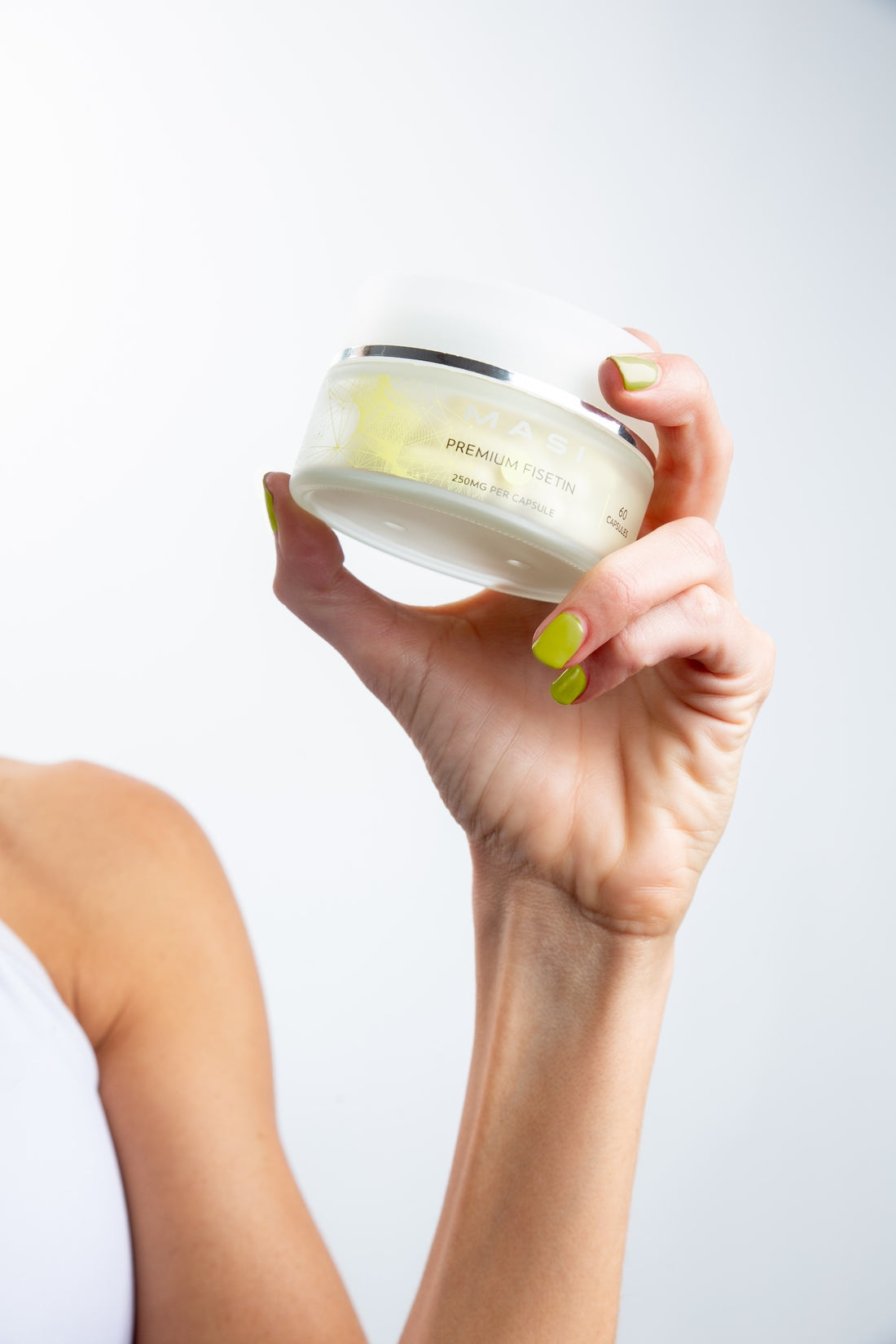
MASI Learn · Safety · Fisetin
Yes — many adults can take fisetin while on other medicines, but fisetin is a concentrated polyphenol flavonoid, not an inert “natural free pass.” The useful question is which prescription contexts need a clinician or pharmacist check first, how human and laboratory research frame fisetin, and how Premium Fisetin sits as a goal-based layer in a MASI program with Premium NMN, Premium Resveratrol, Premium Spermidine and Hair Complex.
This guide answers the medicines question first, maps high-priority clinical situations, then shows a practical multi-month path. It is education from MASI Longevity Science — not personal medical advice and not permission to change a prescription on your own.
Direct answer
Fisetin is a plant flavonoid studied for antioxidant, anti-inflammatory and senolytic-adjacent biology. At fruit-and-vegetable amounts it is a normal dietary compound. At supplement doses, it belongs with other concentrated polyphenols: useful when the goal is clear, and worth disclosing next to complex medicine lists.[1][2]
For product use, that translates into a practical split:
- Often straightforward: generally healthy adults not pregnant or nursing, without anticoagulants/antiplatelets, without oncology or transplant protocols, and without a long specialty medicine list — using label-true Premium Fisetin as a goal-based longevity layer (often intermittent or cycle-style rather than an automatic forever megadose).
- Clinician or pharmacist first: anticoagulants and dual antiplatelet therapy, active cancer therapy, transplant immunosuppression, significant liver or kidney disease, pregnancy/trying to conceive/breastfeeding, narrow-therapeutic-index drugs, and any regimen where your team already restricts supplements.
- Never: using fisetin to replace, taper or “cover for” a prescription you dislike without the prescriber.
What fisetin is — and what it is not
Flavonoid polyphenol
Fisetin is a flavonol found in strawberries and other plants. Longevity interest comes from cellular-senescence and stress-response research, not from disease-cure marketing.[1]
Not NMN
NMN is a NAD+ precursor with a different chemistry and counseling profile. Do not copy NMN “often simple” rules blindly onto fisetin, and do not treat fisetin like a second NMN bottle. See NMN and medicines.
Not a prescription drug
Fisetin is sold as a dietary supplement in MASI’s markets. It is not licensed to treat cancer, clotting disorders, diabetes or any disease. Labels and country rules override blog language.
Not “safer because natural”
Anything bioactive enough to earn multi-week programs can matter next to anticoagulants, chemotherapy and immunosuppressants. Confidence comes from clear product choice plus clinician filters when needed — not from denial.
Human and laboratory evidence map (honest grades)
| Topic | What exists | How MASI uses it |
|---|---|---|
| Senolytic-adjacent / cellular-senescence research | Influential translational and mechanistic work positions fisetin among candidate senolytic flavonoids; human clinical depth is still maturing versus food-use history.[1] | Supports fisetin as a goal-based MASI layer with honest limits — not oncology self-treatment |
| Bioavailability and formulation context | Oral flavonoid exposure depends on dose, matrix and formulation; reviews discuss absorption challenges for fisetin-class compounds.[2] | Prefer label-true products and multi-week evaluation over forum megadose experiments |
| Polyphenol CYP / transporter themes | Laboratory and pharmacokinetic literature shows some polyphenols can modulate drug-metabolizing enzymes and transporters; magnitude is compound- and dose-specific.[3][4] | Reason for pharmacist review when Rx complexity is high |
| Bleeding-risk counseling for polyphenols | Stilbenes and broader polyphenol classes appear in anticoagulant/antiplatelet counseling conversations; strength varies by compound and co-therapy.[5] | Disclose fisetin on bleeding-risk medicine lists; do not self-stack silently |
| Complete fisetin × every drug monograph | No hospital-grade interaction database equivalent for consumer fisetin | Teach high-risk contexts + named product review instead of fake certainty |
| “Fisetin cancels my medicine” | Not a general true statement | Rejected |
| “Fisetin never interacts” | Overconfident for concentrated polyphenols in complex Rx settings | Rejected — sales confidence is quality product + clinician filter when needed |
For stack-wide polyphenol counseling, also read polyphenols and prescription medicines.
Medicine contexts that deserve a real conversation
| Context | Why it comes up with fisetin | What to do in practice |
|---|---|---|
| Anticoagulants / antiplatelets | Polyphenol counseling often includes bleeding-risk pathways and monitoring themes; silent stacking is a poor plan.[5] | Ask the clinician or anticoagulation service before starting or intensifying fisetin. Never stop a blood thinner because of a supplement article. |
| Active oncology / chemotherapy protocols | Senescence biology is scientifically interesting and clinically protocol-specific; teams often control antioxidants and botanicals around cycles. | Only the oncology team green-lights timing. Default is ask first. |
| Transplant / strong immunosuppression | Narrow windows; CYP/transporter themes matter for many agents.[3] | Specialist approval before any concentrated flavonoid capsule program. |
| Significant liver or kidney disease | Clearance and overall risk differ from healthier research volunteers. | Clinician review of the exact product and dose. |
| Polypharmacy (many chronic Rx) | Interaction databases for supplements are incomplete; pharmacists still add value by reviewing the whole list. | Bring the bottle. One new supplement at a time. |
| Pregnancy, trying to conceive, breastfeeding | Longevity trial populations are not obstetric guidance. | Personal medical advice before fisetin. |
| Upcoming surgery / procedures | Teams reconcile all capsules pre-op, especially when bleeding risk is managed. | Disclose fisetin on the medication list; follow perioperative instructions. |
| Diabetes / metabolic Rx | Fisetin is researched in metabolic and aging biology; it is not a licensed diabetes drug and must not replace prescribed care. | Keep medicines stable. Optional nutrient layers only after the medical plan is settled. |
| No chronic medicines | Interaction complexity drops; quality, dose honesty and goal fit dominate. | Use Premium Fisetin after foundation habits; depth on the Fisetin pillar. |
Where fisetin sits in a MASI program
MASI builds longevity nutrition around defined molecules and honest jobs — not around fear copy and not around disease claims.
| Goal | MASI product role | Typical order |
|---|---|---|
| NAD+ / cellular-energy foundation | Premium NMN | Day-one cornerstone for most adults (NMN pillar) |
| Core stilbene polyphenol partner | Premium Resveratrol | Often next, with a meal, once NMN habit is stable (Resveratrol pillar) |
| Senolytic-adjacent flavonoid literacy | Premium Fisetin | Goal-based / intermittent layer — not automatic megadose stacking for everyone (Fisetin pillar) |
| Autophagy-oriented polyamine literacy | Premium Spermidine | Goal-based second layer (Spermidine pillar) |
| Hair-nutrition lane | Hair Complex | Appearance program over months (Hair pillar) |
| Quality literacy | Purity, identity, testing education | Quality pillar |
Practical use when medicines are in the picture
- One change at a time. Keep prescriptions stable. Add fisetin alone (after foundation if possible) so you can read tolerability.
- Label dose, not forum megadoses copied from animal papers or social protocols.
- Bring the bottle to pharmacy consults. “I take anti-aging stuff” is useless; “Premium Fisetin, X mg, schedule Y” is useful.
- With food is common for polyphenol capsules if your stomach is sensitive; follow the product label.
- Intermittent schedules are a legitimate design choice for fisetin in many longevity programs — consistency of the plan beats chaotic stacking.
- If you also take resveratrol, disclose the full polyphenol stack on bleeding-risk lists — see the polyphenol medicines guide.
- Do not stop a medicine because a longevity article sounded optimistic.
Safety checklist (concise, after the plan)
- Not medical advice; not a substitute for labeled prescribing information.
- Oncology, transplant, advanced organ disease, pregnancy/nursing, anticoagulants: specialist or managing clinician first.
- Unexpected bruising/bleeding, dizziness, rash, severe GI symptoms, or major change in a monitored lab: pause and contact a clinician.
- Full molecule map: Learn — safety and interactions.
- Related keepers: NMN and medicines, polyphenols and medicines, fisetin with other supplements.
FAQ
Can I take fisetin with other medicines?
Often yes for adults with simple prescription lists, using a label-true product such as Premium Fisetin. Anticoagulants, oncology care, transplant immunosuppression, significant organ disease and pregnancy-related states need a clinician or pharmacist review of the exact product before you start. Fisetin is not a reason to change prescribed doses on your own.
Is fisetin the same interaction risk as NMN?
No. NMN is a NAD+ precursor. Fisetin is a polyphenol flavonoid with stronger classic counseling themes around concentrated polyphenols, drug-metabolizing enzymes and, in some contexts, bleeding-risk medicines. If your stack includes both, read both keepers.
Can fisetin replace chemotherapy or blood thinners?
No. Fisetin is not licensed to treat cancer or clotting disorders and is not a substitute for prescribed therapy. Keep medical regimens under the clinician who prescribed them. Longevity nutrients are optional layers.
What does research say about fisetin?
Mechanistic and translational work positions fisetin among senolytic-adjacent flavonoids, and reviews discuss bioavailability challenges for oral flavonoids. That supports careful product use and multi-week evaluation — not disease claims or self-directed oncology protocols.[1][2]
Should I stop blood thinners to take fisetin?
No. Never stop anticoagulants or antiplatelets because of a supplement article. Disclose fisetin and any other polyphenols to the clinician managing bleeding risk.
How should I start a 90-day MASI program on medicines?
If cleared or low-complexity: daily Premium NMN first, then consider Premium Resveratrol, then goal-based Premium Fisetin (and spermidine or Hair Complex when relevant). Reassess at about 90 days. If high-complexity: clinician first, then the same sequence.
Where should I go next?
Read the Fisetin pillar for mechanism and use depth, the safety hub for stack-wide posture, and shop Premium Fisetin when the fit is clear.
Selected references
- Yousefzadeh MJ et al. — fisetin and senolytic/aging biology context (PubMed 30281022)
- Fisetin bioavailability / formulation context literature (PubMed 31913191)
- Polyphenol CYP modulation literature (PubMed 18302333)
- Flavonoid–drug interaction / transporter themes (PubMed 19209920)
- Resveratrol/polyphenol cardiovascular and counseling context (PubMed 17086191)
Educational content from MASI Longevity Science. Not medical advice. Product availability and labels can change; always follow the bottle in your market and your clinician’s guidance.

